
From Impressions to Impact: How to Talk Tourism Marketing with the CFO
Tourism marketing is expensive. Between agency fees, paid media, content production, website investments, research, public relations and tech platforms, marketing can represent one of the largest discretionary investments a tourism organization makes each year.
For the people wearing the marketing hats, it’s easy to see the need for that level of investment. But for those wearing the finance hats, drawing a straight line between photoshoot and hotel bookings can be difficult. In order for the marketing team to get a stamp of approval from those safe-guarding the budget, they need to be able to answer one simple question: What are we actually getting for this money?
It is a fair question, but unfortunately for tourism marketers, it doesn’t always come with a simple answer.
The honest truth: tourism marketing is difficult to attribute neatly
Tourism marketing does not behave like many other types of B2C marketing. A product consumer generally follows a relatively direct path from ad click to product page to purchase, but a traveler may take a very different journey. They might first see a destination in a Reel. The next time they are ready to book a vacation they search for it on Google. Then they ask an AI assistant for ideas, check a hotel website, read reviews, save a few restaurants on Maps, talk to friends, return to social media and finally book through an OTA three months later.
Which piece can own the final booking? Usually, it wasn’t a single moment or ad that we can attribute to their reservation in your destination. That is why we think it is more useful to view the modern traveler journey as an ecosystem rather than a funnel.
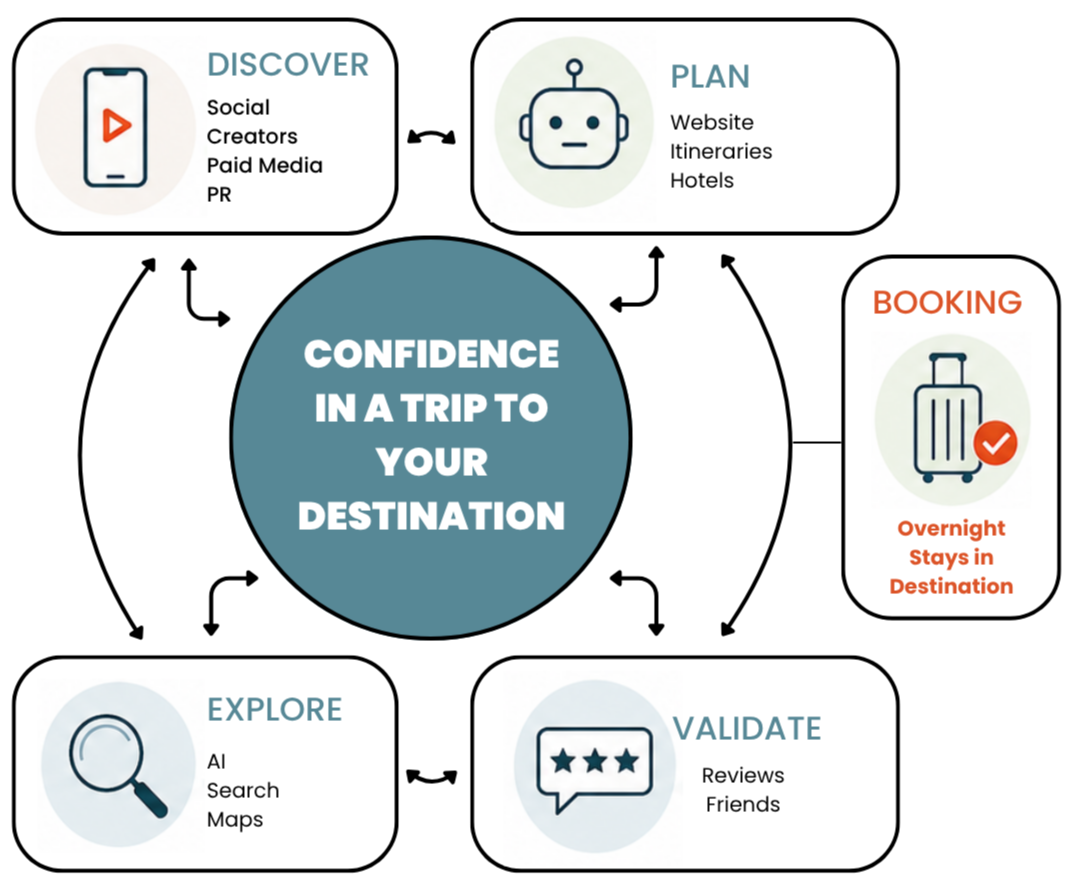
A traveler can enter that ecosystem almost anywhere. They may discover the destination through paid media, content creators, PR features or through word-of-mouth. They may explore it through AI, search or Maps. They may plan through the destination website, Pinterest, itineraries or hotel sites. They may validate the decision through reviews, friends and other travelers. And they may bounce between those touchpoints several times before they finally book.
The role of tourism marketing is not simply to push someone down a straight line. It is to make the destination discoverable, credible and compelling wherever the traveler enters the ecosystem, then make each touchpoint work harder toward an overnight stay. That complexity is exactly why proving ROI can feel uncomfortable in a budget meeting. It is also why relying on one set of metrics doesn’t tell the whole story.
If the finance team needs numbers, give every part of the ecosystem a measurable job
Saying “the traveler journey is complicated” may be true, but it is not a reporting strategy. The marketing team still needs to show that the investment is being managed responsibly. The key is to stop asking every tactic the same question.
Instead of: Did this individual tactic cause a booking?
Ask: What job was this tactic supposed to do, and what evidence tells us it did that job?
That means every part of the ecosystem should have measurable signals attached to it, but there is an important distinction: Performance metrics are not the same thing as ROI.
A CPM tells you how efficiently you bought awareness. A click-through rate tells you whether people responded to creative. A hotel referral tells you someone showed stronger travel intent. Those are all valuable measures, but none of them alone tells a CFO what the marketing investment ultimately returned.
Think of measurement in three layers:
1. Operational performance: Did the tactic work?
2. Traveler behavior: Did people do something differently?
3. Economic impact: What was that changed behavior worth?
Strong tourism reporting needs all three.
Now, let’s break down the ecosystem:
DISCOVER: Are we putting the destination in front of the right travelers?
The purpose is to generate awareness, interest, and initial consideration. This part of the ecosystem includes channels such as: Social media, Content creators, Paid media, Public relations.
Traditional measures may include:
Qualified reach
Impressions
Frequency
Cost per thousand impressions
Video completion rate
Engagement
Earned media reach
Share of voice
Cost per engaged user
Traffic generated from awareness campaigns
Geographic penetration in priority markets
These metrics answer an important operational question: Are we efficiently creating enough qualified awareness to put the destination into consideration?
They do not prove ROI. And that is OK. Travelers cannot book somewhere they have never considered, but awareness is only the beginning of the evidence chain.
EXPLORE: Are travelers actively seeking more information?
Once a traveler has some awareness, the next signal we want to see is curiosity. This part of the ecosystem includes: AI platforms, Search engines, Maps and local listings.
Measurables might include:
Organic search growth
Search visibility
Branded search volume
AI citations or referral traffic
Map views and actions
Website sessions from organic search
Search campaign CTR
Cost per click
Engagement with destination content
New versus returning website users
The finance-friendly question becomes: Are people moving from awareness into active consideration? If reach is growing but search activity, website traffic and destination exploration remain flat, something may not be connecting. That is actionable information.
PLAN: Are travelers moving closer to a decision?
This is where tourism organizations can begin measuring stronger intent. This part of the ecosystem includes: The destination website, Itineraries, Hotel listings, Lodging partner sites, Trip-planning content.
Useful signals include:
Hotel referral clicks
Booking-engine referrals
Partner website traffic
Itinerary views
Event or attraction page engagement
Trip-planning downloads
Email sign-ups
Time spent on planning content
Repeat website visits
Cost per high-value website action
A hotel referral is not a confirmed room night. But it is stronger evidence of intent than an impression. The important thing is to recognize that these metrics are part of the path toward proving value, not the final ROI calculation.
VALIDATE: Are we giving travelers enough confidence to choose us?
Travelers do not simply need inspiration, they need reassurance that the destination will deliver the experience they expect. This part of the ecosystem is often overlooked because much of it sits outside the destination organization’s direct control.
It includes: Reviews, Word of mouth, Social proof, Friends and family, User-generated content.
Measurables may include:
Review volume
Average ratings
Sentiment trends
Social mentions
Saves and shares
User-generated content
Creator engagement
Referral traffic
Survey data
Destination perception research
The question here is: Are travelers finding enough independent validation to move from consideration to confidence? Again, this is not direct ROI, it is evidence that other parts of the ecosystem are doing their job.
BOOKING AND DESTINATION OUTCOMES: What changed in the real world?
Ultimately, the CFO is going to care most about outcomes such as:
Room nights
Booking volume
Visitation
Visitor spending
Length of stay
Lodging revenue
Tourism-related tax revenue
Economic impact
Lodging indicators such as occupancy, ADR and RevPAR are also important, but they need to be interpreted carefully. Occupancy can change because of hotel supply. ADR can rise because of pricing. RevPAR can improve for reasons unrelated to marketing. Tax revenue can increase because rates increased even if visitation did not. These are important business indicators, but they are not proof of marketing impact on their own.
The stronger question is: What changed because of the marketing?
Incrementality for tourism marketing: can we actually prove ROI?
Yes, but the word incremental matters. The strongest tourism marketing ROI measurement does not simply ask how many visitors arrived or how much money they spent during a campaign period.
It tries to determine how many additional visits, bookings, room nights or dollars in visitor spending occurred because of the marketing that would not otherwise have happened.
Sojern's current destination ROI guidance identifies methods including exposure-to-arrival attribution, booking and search data, incrementality testing and brand-lift studies. It also emphasizes that measurement planning needs to happen before a campaign launches, not after the fact.
Research firms such as Longwoods use control procedures intended to isolate the effect of destination advertising from other influences, including economic conditions, weather and pricing, then estimate incremental trips and spending.
Arrivalist uses a similar concept by comparing exposed travelers against statistically matched people who were not exposed to the advertising, with the difference between the groups representing measurable lift.
That means a destination can move beyond saying: “Our campaign reached 2 million people.”
and toward: “Travelers exposed to our campaign were measurably more likely to visit, producing an estimated X incremental trips and Y in visitor spending.”
That is a very different budget conversation.
What does tourism marketing ROI actually look like?
At its simplest: Incremental economic value generated ÷ Marketing investment = Return on marketing investment.
Destinations International recommends a business-minded approach that compares the value generated through DMO activity with the investment required to produce it. Its framework includes measures based on visitor spending, economic impact and tax revenue.
For example: A destination invests $200,000 in a campaign. Research determines that the campaign generated an estimated 3,000 incremental trips. Those incremental visitors generated an estimated $1.5 million in visitor spending.
The destination can report: $1.5 million ÷ $200,000 = $7.50 in incremental visitor spending for every $1 invested. Or perhaps the finance team is more interested in public revenue. If those incremental visitors generated $120,000 in local tax revenue, the organization could separately report: $120,000 ÷ $200,000 = $0.60 in local tax revenue generated per $1 of marketing investment.
Those are two different ROI measures, neither should be confused with impressions, clicks or total destination spending. The important thing is being very clear about what is being counted as the return and how much confidence the organization has that marketing actually influenced it.
Not every destination needs the same level of attribution
This is also where practicality matters. Not every tourism organization has the budget or data infrastructure for a control-group study or sophisticated booking attribution program. A smaller TBID should not be expected to measure marketing exactly the same way as a state tourism office with a multimillion-dollar budget.
Instead, think of measurement as a maturity ladder.
Basic: Media performance + website behavior + hotel referrals + destination-level lodging trends
Better: Add visitation data, booking signals, source-market analysis and stronger high-value-action tracking
Strong: Add exposure-to-arrival or booking attribution
Best: Add incrementality/control-group analysis and translate the incremental activity into visitor spending, tax revenue and ROI
The goal is not to buy every measurement tool available, it is to move toward the strongest level of evidence that is realistic for your organization and budget.
So, how should you evaluate your agency partner?
If marketing accountability matters, the agency's job cannot start and stop with producing creative or buying media. A strong tourism agency partner should help design the measurement strategy before the campaign begins.
That means helping the organization establish:
What the business objective actually is
Which traveler behaviors would signal progress
Which KPIs belong to each part of the ecosystem
Which outcomes the organization ultimately wants to prove
Whether attribution or incrementality measurement is feasible
What tracking and data partnerships need to be in place before launch
How results will be communicated to the board, CFO or other stakeholders
Once campaigns are running, the agency should be able to explain:
What each tactic is supposed to accomplish
Whether it is performing that job efficiently
How the branches of the ecosystem reinforce one another
What the agency is learning from the data
How those insights are changing audiences, creative, media mix and spending
What the data can and cannot credibly prove
The value of an agency is not simply the number of ads it produces. A strong tourism agency partner helps orchestrate the ecosystem, identify where it is working, diagnose where it is breaking down and make the total investment perform better. Just as importantly, that partner should help the internal marketing team translate the complexity into a clear business story for leadership.
Half the job is driving better performance. The other half is helping you explain what the investment is doing, what the numbers mean, what they cannot prove and why the strategy deserves continued confidence.
What your CFO actually needs from the marketing team
Most finance leaders do not need or want to become tourism marketing experts. They need confidence that the organization knows what it is buying, how it is evaluating the investment and whether the money is producing meaningful value.
Ultimately, they need answers to five questions:
1. What did we invest? Be transparent about agency fees, production, media, research, technology and other costs.
2. What changed because of that investment? Move beyond campaign delivery whenever possible and identify incremental visits, bookings, room nights or other behaviors influenced by the work.
3. What was that change worth? Translate those outcomes into the financial language that matters to the organization, whether that is visitor spending, lodging revenue, economic impact or tax revenue.
4. How confident are we that marketing caused it? Be candid about methodology. Was the result directly attributed? Modeled? Based on a control group? Correlated with overall market performance? Strong reporting does not hide uncertainty.
5. What are we doing differently because of what we learned? Perhaps the most important question of all. Marketing should not be treated as a fixed annual expense that repeats itself regardless of performance. The organization should be able to show how insights are changing targeting, creative, channels, timing and budget allocation.
The goal is not to assign a dollar value to every impression, it is to show that each part of the traveler ecosystem has a measurable job, that the ecosystem is producing observable traveler behavior, and that the organization is doing everything reasonably possible to connect that behavior to incremental economic impact.
When that story is clear, the conversation changes. Instead of asking: “Can you prove this Instagram post caused a booking?” The organization can ask: “What did our marketing investment change, what was that change worth, and how do we know?”
That is a much stronger way to evaluate tourism marketing. And a much more credible way to move from impressions to impact.